 Iconic Global

By Editorial Team
Nairobi, Kenya
For decades, international summits involving Africa followed a predictable, tired script: wealthy Western nations acting as benefactors, and African states arriving as supplicants.
But at the Kenyatta International Convention Centre (KICC) in Nairobi, that script wasn’t just revised—it was completely rewritten.
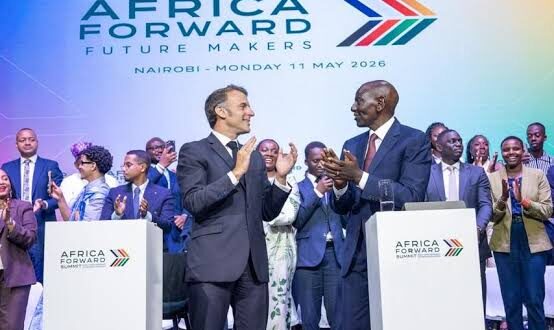
The newly concluded Africa Forward Summit 2026 (held May 11–12) brought together over 30 African Heads of State, French President Emmanuel Macron, and nearly 4,000 global investors, CEOs, and youth leaders. Co-chaired by Kenyan President William Ruto and President Macron, the summit marked a historic paradigm shift. Hosted for the very first time in a non-Francophone African nation, the event signaled a deliberate departure from old spheres of influence, ushering in a futuristic Africa-France partnership anchored on equity, co-investment, and economic sovereignty.
1. The Death of the ‘Handout’ Mentality
The defining undercurrent of the two-day summit was a fierce, collective rejection of traditional foreign aid in favor of hard enterprise.
Speaking to a packed room of heads of state and global financiers, Tony O. Elumelu, CFR, Founder and Group Chairman of Heirs Holdings, delivered a blunt message that set the tone for the event:
”We welcome true partnership—partnerships of substance and based on equity—where Africans and African solutions catalyze Africa’s future. Our youth do not need handouts; they need jobs, they need improved access to electricity, they need to join the internet.”
With over 65% of the continent’s population under the age of 35, African leaders and business titans made it clear that the continent’s youth are an economic powerhouse to be leveraged, not a crisis to be managed.
2. Unlocking the ‘Risk Premium’ and Financial Firepower
A central battlefield at the summit was the reform of the global financial architecture. For years, African leaders have argued that the international system unfairly inflates the “risk premium” associated with African investments, choking out local industrialization.
To combat this, the summit achieved a massive breakthrough for the operationalization of the New African Financial Architecture for Development (NAFAD).
The Financial Blueprint: Scaling ATIDI
The Anchor: The African Development Bank (AfDB) Group secured immense political momentum to back the African Trade & Investment Development Insurance (ATIDI), a Nairobi-based pan-African investment and credit insurer.
The Strategy: ATIDI will act as a continental first-loss guarantee mechanism. By leveraging AfDB’s triple-A balance sheet, this framework aims to pool risks, lower borrowing costs, and crowd in billions in long-term private institutional investment.
Global Backing: President Macron explicitly endorsed this paradigm, committing France’s support to scale ATIDI, calling it the blueprint for Africa’s “strategic autonomy.”
3. Nigeria Leads the Charge on Industrial Sovereignty
Representing Africa’s largest economy, Nigerian President Bola Tinubu delivered a powerful critique of the structural traps that keep Africa’s share of global manufacturing value-added below 2%.
”We export raw minerals, crude oil, and agricultural commodities, and we import processed goods at a premium,” Tinubu stated, linking this directly to an international financial architecture that starves African industries of affordable capital.
Tinubu positioned Nigeria not as an applicant for charity, but as a reformed, highly competitive powerhouse. He highlighted Nigeria’s bold, sovereign reforms—including the removal of fuel subsidies, unification of the exchange rate, and a $3.4 billion banking recapitalization—which have successfully driven the country’s projected 2026 debt-to-GDP ratio down to 32.3% and bolstered external reserves to $45.5 billion.
From Dialogue to Delivery
The summit also played host to the 10th France-Nigeria Business Council Meeting, chaired by Aigboje Aig-Imoukhuede. Attended by industrial titans like Aliko Dangote, Abdul Samad Rabiu, and TotalEnergies CEO Patrick Pouyanné, the session yielded immediate bilateral victories, including a landmark deal between Accor and the Shoreline Group to launch Nigeria’s first national hotel platform.
4. Key Pillars of the Nairobi Declaration
As the curtains fell, the adoption of the Nairobi Declaration outlined concrete operational frameworks across several modern verticals:
Digital & AI:
The rollout of the AI 10 Billion Initiative (launched alongside the AfDB and UNDP) to foster regional tech hubs and digital infrastructure.
Green Industrialization: Directing Euro-African private capital into the blue economy, strategic port development, and renewable energy grids.
Health Sovereignty: Funding formulas scaled to transition Africa from a vaccine importer to a hub for localized pharmaceutical manufacturing.
Peace & Security: A unified demand for a stronger, more autonomous African Union voice within international bodies, emphasizing that continental unity is the prerequisite for economic stability.
The Verdict: A Blueprint for the G7
The Africa Forward Summit 2026 was not just another talking shop. It successfully married political will with institutional private capital. By moving the conversation from “development aid” to “risk mitigation and co-investment,” Africa has laid down a new template for international diplomacy.
The resolutions carved out in Nairobi are slated to heavily inform the upcoming G7 Leaders’ Summit in Evian, France. The message from Nairobi to the rest of the world is now undeniable: Africa is no longer just a market of the future—it is a co-architect of the global present.
